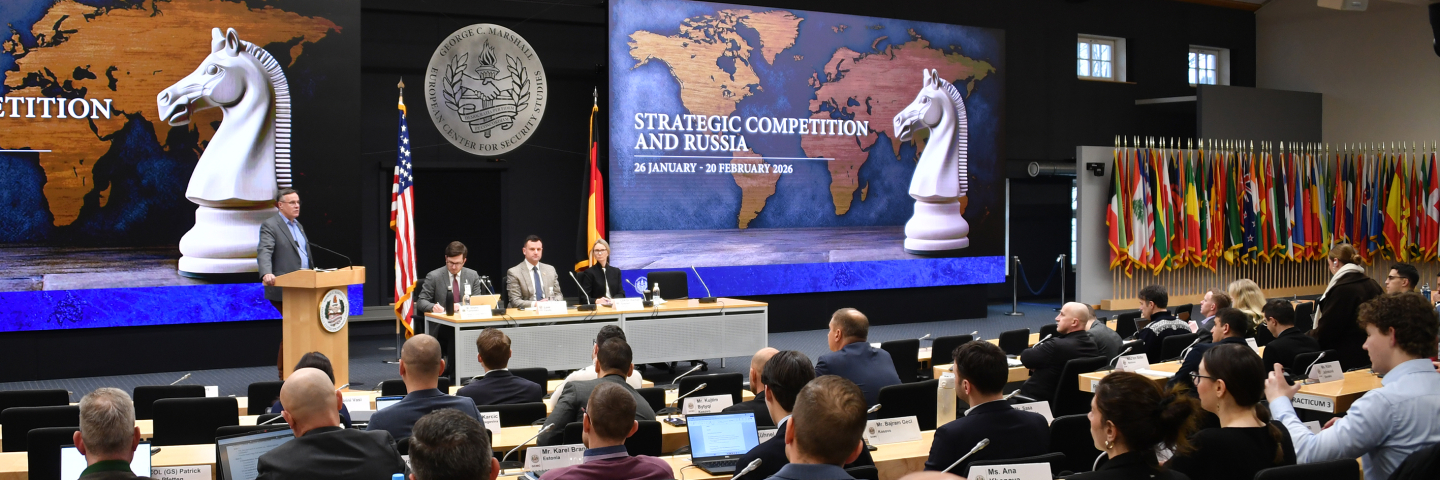
Strategic Competition and Russia sets Standard for Marshall Center’s 2026 Skills-Based Training Model
Feb. 25, 2026
The Marshall Center’s inaugural resident course of 2026 concluded Feb. 20, 2026, marking not only the end of four intensive weeks of study, but the formal launch of the Garmisch-Partenkirchen based security cooperation center’s redesigned program model.
“You don’t just come here to learn—you come here to connect. This network will support your institutions, your nations, and the broader security environment we all share,” said Barre Seguin, Marshall Center director. “You are also the first ambassadors of this refreshed model. Your commitment, your curiosity, and your willingness to engage have set the standard for the year ahead.”
Over the course of the program, participants explored how strategic analysis, skills-based training, and regional expertise combine to help nations assess, align, and advance European-led defense. Sessions encouraged critical thinking about how strategy is developed and implemented, and how national approaches can better meet evolving security challenges.
“I'm usually the practitioner among academics, and this time I felt like I was more of the academic among practitioners,” said Oana Zamfir, GlobalFocus Center director. “This was extremely important to me personally because it really helped me place myself at the intersection of expertise, analysis, and practice, and figure out more about what skills I have and what I need to advance my professional goals further.”
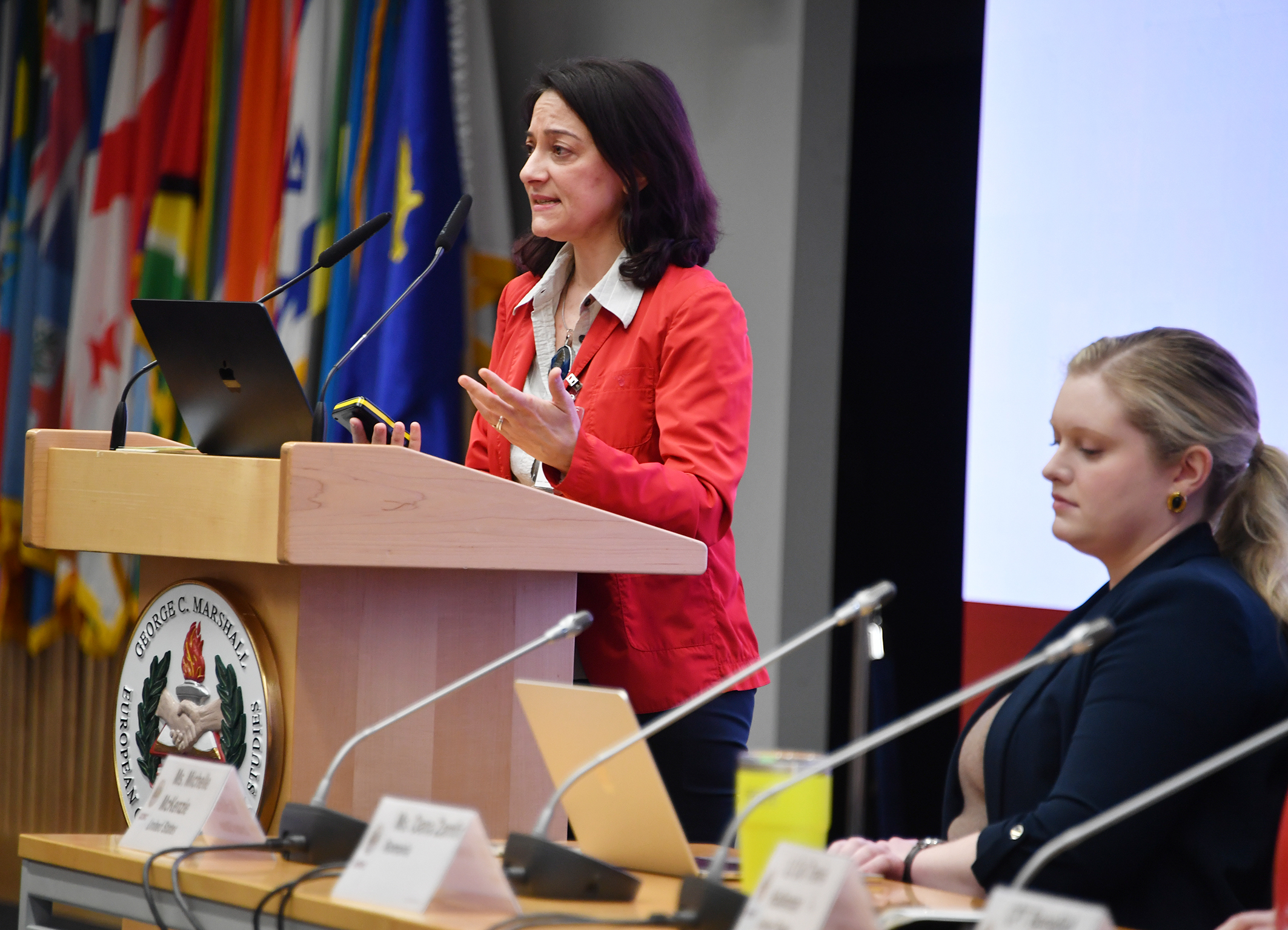
Throughout the course, participants heard from many senior leaders, ambassadors, scholars, and practitioners bringing firsthand experience to inform the strategic dialogue that defines the Marshall Center.
“We want our children and our grandchildren to live in a beautiful, peaceful world. But unfortunately, the only way to get there is for a certain part of our societies to be prepared to fight,” said Retired U.S. Army Gen. Christopher Cavoli, former commander, U.S. European Command, and NATO Supreme Allied Commander Europe. “And that's the job of the military, and that's the job of the people who attend courses like this to prepare those units and to build those organizations, to be ready to do what we don't want to do.”
Participants examined strategic competition in depth, drawing on the experience of more than 70 security professionals in plenary sessions and practicums to exchange perspectives and discuss potential solutions. With particular focus on Russia’s behavior, decision-making, and use of information, sessions encouraged critical thinking about how strategy is developed and implemented.
“The presentations are full of good takeaways, and I think any presentation could probably be spun into a full day, or maybe even a full week of instruction.” said David Gioe, Ph.D., U.S. European Command Foreign Area Officer. “The expertise in this room seems to be unrivaled.”
Beyond the classroom, the Marshall Center’s network remains one of its greatest strengths. Participants depart not only with sharpened analytical tools, but with trusted counterparts across the transatlantic community and beyond—relationships designed to endure well beyond the four-week program.
As the first cohort of the 2026 program plan, the Marshall Center’s newest alumni leave prepared to strengthen strategic thinking and support European-led deterrence and defense.