Parliamentary, U.S. Congressional Staffs Examine Defense Oversight Amid Rapid Technology Change
Aug. 28, 2026
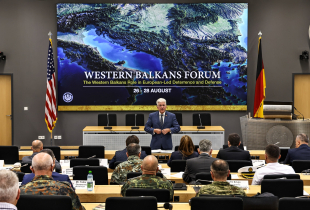
The George C. Marshall European Center for Security Studies hosted a two-day House Democracy Partnership Workshop from Aug. 24-25, 2026, bringing together 24 participants from U.S. congressional offices, European parliamentarian staff, and the NATO Parliamentary Assembly to examine the implications of rapid technological change and increasing defense investment.
Through a series of panel discussions and seminars, followed by small working groups and participant presentations, attendees examined the challenges and opportunities now facing governments.
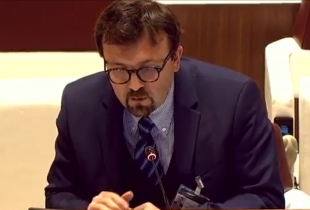
“The challenge is to understand how new capabilities are prioritized, resourced, and acquired, while ensuring effective democratic oversight so that intent translates into capability without eroding public trust,” said Tim McAteer, Marshall Center deputy director.
The format, incorporating themes such as stewardship, information sharing, collective security, and the threat landscape, allowed participants to compare approaches and exchange perspective.
“A changing global security environment and the rise of AI and disruptive technologies necessitate policymakers to respond.” said Marc Ozawa, Marshall Center faculty and workshop lead. “Parliamentary staffers are the backbone of this process, and in this workshop, participants from the U.S. and across Europe work to find solutions together.”
The working groups ultimately identified several practical approaches. Participants called for greater in-house expertise within legislative institutions, including drawing on personnel with military and defense backgrounds. They also stressed that emerging technologies should not be treated solely as information technology issues, but considered for their broader implications across defense policy, acquisition, operations and oversight.
Participants also examined how governments can strengthen resilience by understanding vulnerabilities across critical supply chains and infrastructure. Red-teaming emerged as one approach, with decision-makers and other stakeholders deliberately examining systems from an adversary’s perspective to identify weaknesses before they can be exploited.
“We appreciate the House Democracy Partnership and our participants for making this exchange possible,” Ozawa said.
The workshop comes shortly after the Marshall Center formalized its Transatlantic Industrial Readiness Program, which brings together military, government, industry, and security practitioners to address capability gaps. The complementary program and workshop provide a through-line in supporting European Allies and partners as they turn defense investment into credible capability.
The workshop was part of the House Democracy Partnership’s broader effort to strengthen legislative institutions through peer-to-peer exchanges, training, and technical assistance. By promoting accountability, transparency, and legislative capacity, HDP creates environments that support economic growth, strengthen regional security, and reinforce partnerships.