Defending the Homeland: Europe at the Crossroads in Countering Transnational Organized Crime
Oct. 2, 2026
Transnational organized crime is no longer viewed solely as a law enforcement challenge. It is increasingly recognized as a threat to national security, economic resilience, and homeland defense. As criminal networks expand across borders and intersect with hostile state actors, terrorist groups, and emerging technologies, Europe has become a key arena where many of these threats converge before reaching North America.
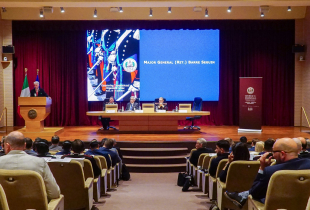
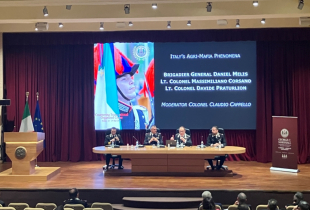
These challenges were the focus of the George C. Marshall European Center for Security Studies' two-day Countering Transnational Organized Crime (CTOC) program, held in Lisbon, Portugal, Sept. 28-29. Under the theme, "Securing the Logistics Backbone: Cartels, Malign Influence, and Threats to Military Capacity," participants examined how criminal networks exploit ports, supply chains, and other infrastructure essential to economic security and military readiness.
Opening the program, U.S. Ambassador to Portugal John J. Arrigo framed the challenge in strategic terms. "To understand why we're here, we first need to understand what we're up against. Organized crime today isn't just a law enforcement problem. It's a strategic security threat."
That assessment aligns with a growing recognition across the U.S. government that countering transnational organized crime is essential to protecting the homeland.
As Maurice L. Todd, Ph.D., assistant secretary of war for readiness, noted in his virtual address to the conference participants: “We are now taking a more direct role countering transnational criminal organizations because they are no longer just a law enforcement threat. They have become a threat to our national security and the security of our allies and partners that is being felt on our own doorstep, and protecting the homeland is our top priority,” Todd said. “As a result, we are focusing a wide range of highly effective military, intelligence, economic, political, and law enforcement resources in cooperation with our allies and partners to defeat them.
"If we can't defend our own borders and assist our friends to defend theirs, we can't protect the homeland.”
That message guided discussions throughout the conference, which focused on how defending the homeland increasingly depends on disrupting criminal networks abroad, securing borders, protecting vital infrastructure, and strengthening cooperation among allies and partners.
Participants emphasized that threats to the U.S. homeland often originate far beyond America's borders. Criminal networks exploit vulnerable ports, logistics hubs, and financial systems to move narcotics, illicit funds, trafficked persons, and other illegal commodities through routes connecting Latin America, Africa, Europe, and North America.
Attention focused on major ports which serve as critical gateways for global trade but are also exploited by criminal networks. Their significance extends beyond commerce. More than 90 percent of the equipment and supplies needed for major U.S. military operations move by sea, making commercial ports critical to both economic security and military readiness.
Crime, Terrorism, and Hostile State Actors
A recurring theme was the growing convergence between transnational criminal organizations, terrorist groups, and hostile state actors. While their motives may differ, they often exploit the same routes, technologies, financial systems, and governance gaps.
Participants discussed concerns that some state actors have leveraged criminal networks to advance broader strategic objectives, while organized crime continues to thrive where corruption and weak institutions create opportunities for exploitation. Criminal activity can also generate revenue streams that support extremist groups and fuel instability that threatens U.S. and allied interests.
Addressing these interconnected challenges, participants argued, requires a whole-of-government approach that integrates law enforcement, intelligence, diplomatic, and defense capabilities.
Another key focus was protecting the infrastructure and supply chains that underpin both economic prosperity and national security. Criminal networks increasingly target transportation systems, ports, customs operations, and financial channels vital to global commerce. These vulnerabilities extend beyond narcotics trafficking to include illicit finance, precursor chemicals, cyber-enabled crime, and human trafficking.
Participants also examined concerns about strategic competitors gaining influence through investments in critical infrastructure and supply chains. Strengthening resilience and reducing vulnerabilities were identified as essential to ensuring that economic dependencies cannot be exploited to undermine U.S. and allied interests.
International Cooperation as a Decisive Advantage
Because criminal networks operate across jurisdictions and continents, participants agreed that international cooperation remains one of the most effective tools for defending the homeland. Information sharing, joint investigations, liaison officers, and fusion centers were highlighted as proven mechanisms for identifying and disrupting threats before they reach U.S. borders.
As Ambassador Arrigo noted: "We must build lasting partnerships. Training and joint investigations don't just solve today's cases; they build long-lasting relationships and institutions strong enough to outlast tomorrow's threats."
That emphasis on partnerships resonated throughout the conference. Participants repeatedly stressed that criminal networks often adapt faster than government institutions, rapidly shifting routes, exploiting new technologies, and taking advantage of jurisdictional gaps.
Marshall Center professor and CTOC Program Director, Cüneyt Gürer, Ph.D., argued that staying ahead of those threats requires an equally agile network of practitioners.
“Criminal networks adapt faster than institutions, shifting to smaller ports, new routes, and at-sea transfers the moment we close a gap. The only thing that keeps pace with a network is another network,” he said. Gürer described the CTOC community as a standing, cross-border network that enables professionals to share insights, build trusted relationships, and develop strategic approaches to shared challenges. “The only thing that beats a network is a better network. That's CTOC.”
Brig. Gen. Giuseppe De Magistris, assistant director of the Italian Carabinieri, highlighted the importance of the rule of law, strong community partnerships, and international cooperation in countering evolving criminal threats. Drawing on Carabinieri’s extensive experience combating organized crime, he emphasized the value of allied cooperation in strengthening collective security.
The conference concluded that transnational organized crime exploits many of the same weaknesses as terrorists and hostile state actors, including corruption, weak governance, fragmented institutions, and emerging technologies. Countering these threats requires closer cooperation among allies, stronger information sharing, and continued investment in the capabilities that support collective security.
As Ambassador Arrigo observed, "Our adversaries are connected, so we must be even more connected."
The conference reinforced a strategic reality: protecting the homeland starts well beyond U.S. borders. Europe has become a key front in the fight against transnational organized crime, and working with allies to disrupt criminal networks, secure critical infrastructure, and close gaps in global security will be essential to stopping these threats before they reach the United States.