Bridging Innovation and Capability: Marshall Center DIB Workshop
April 28, 2026
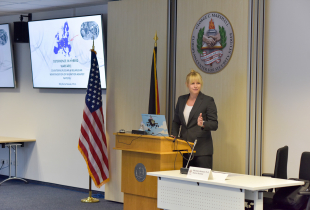
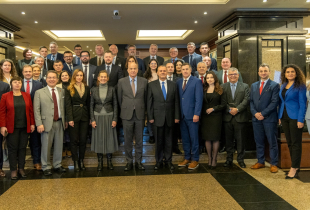
Taking lessons from Ukraine to inform European efforts toward credible, combat-capable forces and industry, the Marshall Center convened more than 100 professionals, industry experts, and policy implementers on April 24, 2026, at BWI GmbH in Munich for its inaugural Defense Industrial Base (DIB) In-Region Workshop.
The goal: advance the DIB, an ecosystem the Marshall Center actively contributes to by bridging knowledge gaps in support of credible deterrence and defense.
“We are focused on generating capability from increased spending, with Europe assuming greater responsibility for its conventional defense,” said Barre Seguin, Marshall Center director. “The defense industrial base is central to that shift, utilizing Europe’s strength in talent and resources.”
Panels and guest speakers spanned a range of expertise and practitioners, from Ukrainian officials innovating on the battlefield in defense of their nation to industry experts working on air and missile defense systems for credible deterrence in Europe.
Seguin noted that past constraints—from funding shortfalls to limited political will and a lack of urgency—no longer define the landscape. Those positioned to act recognize the moment, with forums like this helping connect efforts, even as cooperation remains complex.
“The assumptions that shape European defense have changed. It’s not enough to spend more – what matters is the capability that spending produces,” Seguin said.
The workshop focused on innovation as a strategic advantage, with input from former and current Ukrainian officials. Drawing on more than four years of war, participants examined how rapidly evolving tactics are shaping requirements for European security. Their perspectives served as the connective tissue of the workshop, linking concept to reality and reinforcing how battlefield adaptation is driving changes across training, decision-making, and industrial requirements.
“We cannot take our participants to Ukraine, but we can take lessons from the battlefield in Ukraine to our participants and translate them into lessons and actionable outcomes for European defense,” said Yevgeniya Gaber, Marshall Center professor and workshop co-lead.
A central theme was the integration of emerging technologies at the tactical level, highlighted by U.S. Army Brig. Gen. Terry Tillis, commander, 7th Army Training Command, who is currently leading a major training exercise incorporating these lessons.
“There is an autonomous zone beyond the forward line of troops where autonomous systems and advanced technologies are shaping the fight—and we have to win there first,” Tillis said. “The battlefield has changed; to adapt strategically, we must also get it right at the tactical level.”
His remarks underscored how rapidly the fight is evolving at the tactical level. Keeping pace requires a range of efforts, from updated training with allies and partners – where lessons learned are being integrated in real time – to a more agile defense industrial base.
Building on Tillis’ remarks, the same urgency was echoed by workshop partner BWI GmbH, whose digital wargaming approach integrates operational knowledge more rapidly into planning and capability development. The emphasis is on momentum over perfection, recognizing that modern warfare has become an innovation race, where competition across organizations reduces risk and ensures progress.
“Today was another step in the process of creating a community of expertise focused on European-led defense and the defense industrial base,” said Monika Wohlfeld, Marshall Center professor and workshop co-lead.
Participants then broke into working groups to get after the barriers shaping the defense industrial base. Discussions focused on how political frameworks and legal authorities can better match operational realities, alongside defense innovation ecosystems, procurement and acquisition reform, AI, and NATO–EU cooperation. Across the groups, the conversation stayed practical—how to better align these pieces to deliver capability, a tangible takeaway for those in attendance.
“We have exactly the right group in the room to develop strategic recommendations that strengthen the connection between military and industry,” said Kay Brinkmann, Marshall Center German deputy director. “When we talk about the defense industrial base, we cannot look at industry alone – we have to look beyond it. What stood out today was how we moved from theory to practical application.”
The DIB In-Region Workshop brought together 23 Marshall Center alumni, 40 participants from the European-Led Defense course, and a mix of industry representatives, government leaders, and Marshall Center faculty to facilitate direct engagement with innovators, industry partners, and experts shaping the future of the defense industrial base.